🏛️ ANCIENT DRAVIDIAN HERITAGE

The Ancient Art of Pallanghuzhi, Reborn for the Digital Age

Experience Tamil Nadu’s 2,000-year-old 14-pit heirloom strategy game. Featuring tactile step-by-step sowing, theatrical AI attitudes, authentic acoustic cowrie shell clatter, and sacred cow rules.
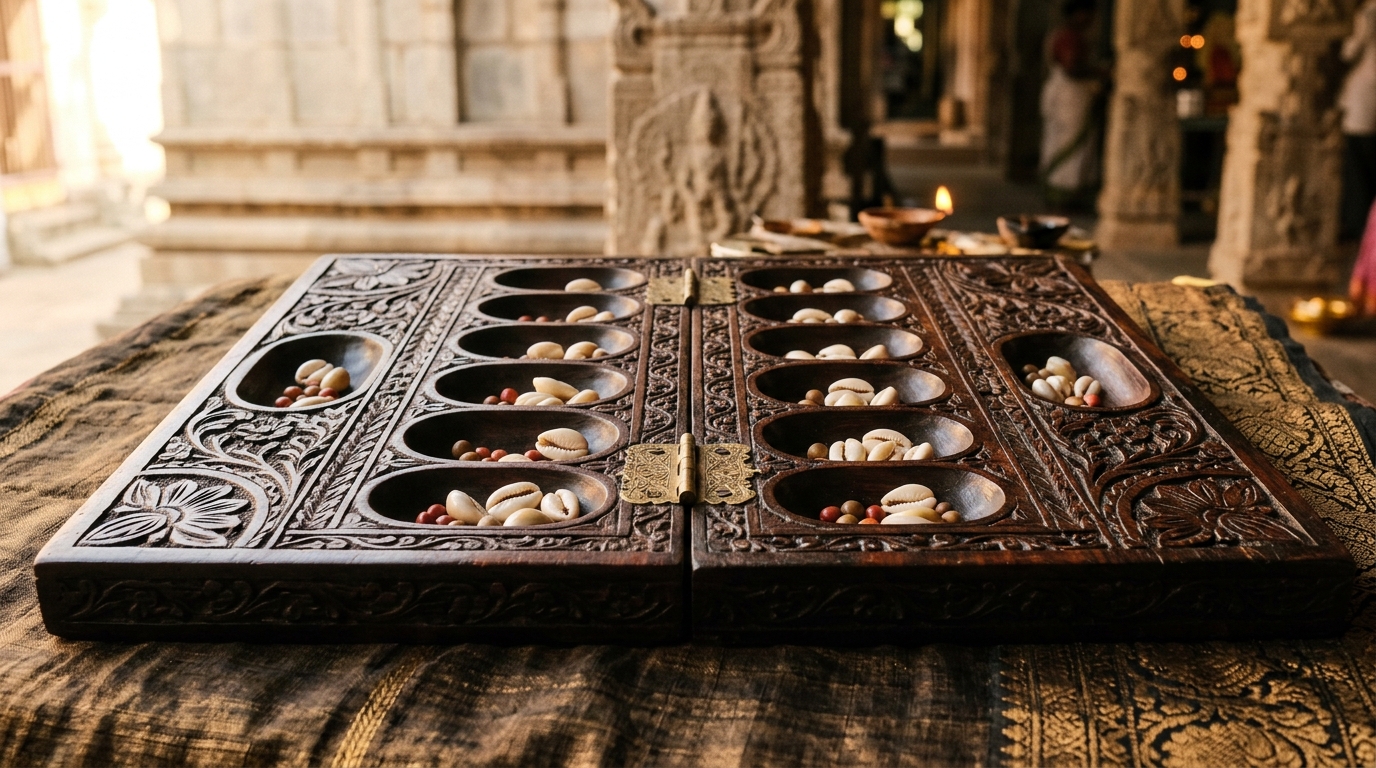
Antique Heirloom 14-Pit Pallanghuzhi Board with Cowrie Shells
Heirloom Rosewood Board
14 Pits • 70 Genuine Cowrie Shells
👆
Full Manual Mode
Tactile step-by-step sowing & scoops
🐚
Acoustic Audio Engine
Dual-tier Web Audio API shell models
🤖
Expressive AI Attitude
Beach lounger, knuckle crack, robot arm
🐄
Auspicious Pasu Rule
4-shell cow claims with sacred moo audio

A 2,000-Year-Old Game of Mathematics & Wit

Originating in the Sangam era of Tamil Nadu, Pallanghuzhi (பல்லாங்குழி — literally "Fourteen Pits") is India’s foremost ancient traditional strategy game. Hand-carved from fragrant rosewood, teak, or brass, these heirloom boards were passed down across generations from grandmothers to grandchildren.

"Pallanghuzhi is not a game of chance. It is an algorithmic dance of distributed sowing, mental arithmetic, and strategic patience."

Beyond entertainment, Pallanghuzhi was an ancient cognitive training tool, teaching quick calculation, resource conservation, and hand-eye coordination using natural cowrie shells (Sozhi / Choli) or tamarind seeds (Puliya Muthu).

🌱 Vithu Idam (Seed Sowing)

The gentle counter-clockwise rhythmic distribution of shells across circular pits, teaching patience and continuous flow.

🐄 The Pasu (Sacred Cow) Custom

When exactly the fourth shell lands in any pit, it transforms into an auspicious Pasu (Cow), awarded to the lucky player!

🛡️ Kasavu Kuzhi (Sanctuary Pits)

Pits with deficits are protected by sacred resting figurines (Royal Elephant, Kamadhenu Cow, Playful Puppy, and Kitten).

The Same Board, Called a Hundred Ways

Every language along the Deccan gave this 14-pit board its own name. The wood is the same size, the counters are the same shells and the arithmetic is the same — only the words change from valley to valley.

Tamil Nadu
பல்லாங்குழி

Pallanghuzhi / Pallanguzhi / Pallankuzhi

“Fourteen pits” — the Tamil name for the 14-cup board, and the variant this app plays. Also written Pallanguzhi or Pallankuzhi.

Karnataka
ಅಳಿ ಗುಳಿ ಮಣೆ

Ali Guli Mane

“A wooden block with holes.” The Kannada name for the same board — and the same idea behind this app’s own name, Pallanghuzhi, which means “many holes” in Kannada.

Tulu Nadu
ಚೆನ್ನೆಮಣೆ

Chenne Mane / Chennemane

The Tulu name, on the coast where the game is still played daily on carved Chenna Mane boards.

North Karnataka
Akal Patta

The Northern Name

The name used across North Karnataka for the same 14 pits and the same 70 seeds — the cousin game our rules are closest to.

Maharashtra
सत्कोलि

Satkoli

The Marathi name, carried north across the border with the same board and the same rules.

Malaysia & Indonesia
Congkak

The Nearest Cousin

The mancala game of the Malay world. Ali Guli Mane is most often played as Congkak, in the very same handicapped series format.

Pallanghuzhi & Ali Guli Mane: same family, close cousins

Both games are played on two rows of seven holes with 70 seeds, and both scoop the next pit the moment your hand runs dry. The details differ just enough to be worth knowing — and they explain where some of Pallanghuzhi’s own customs came from.

  Pallanghuzhi — Tamil Nadu Ali Guli Mane — Karnataka
Board 2 rows of 7 holes, 70 seeds 2 rows of 7 holes, 70 seeds
Seeds per hole 5 (or 6) 5, 7 or 12
Sowing direction Fixed, counter-clockwise Clockwise or anti-clockwise — the player’s choice
Empty hand Scoop the next pit and keep sowing Scoop the next pit and keep sowing
Blank capture Take the one pit after the blank Take the pit next to the blank and the opposite pit
Turn length One sowing Up to two sowings, if the first one captures
Match format Multi-round, with Kasavu Kuzhi sanctuary pits Handicapped Congkak series with “protected” holes
The two traditions have already crossed over. A player who falls short of shells closes their pits in Pallanghuzhi — the Kasavu Kuzhi sanctuaries — while an Ali Guli Mane series sets the surplus aside as “already captured” and marks the empty cups as protected holes that are never played again. Same idea, two neighbouring tongues.

Regional names and rule differences after Ali Guli Mane on Wikipedia (CC BY-SA 4.0), cross-checked against the rules implemented in this app.

Explore the 14 Pits & Dual Stashes

Click any pit below to inspect its traditional Tamil orientation, seed allocation, and role in circular match play.

💰
P2 STASH
35
B7
🐚 5
B6
🐚 5
B5
🐚 5
B4
🐚 5
B3
🐚 5
B2
🐚 5
B1
🐚 5
A1
🐚 5
A2
🐚 5
A3
🐚 5
A4
🐚 5
A5
🐚 5
A6
🐚 5
A7
🐚 5
💰
P1 STASH
35
Selected Pit
Pit A1 (Home Starting Corner)
Contains 5 golden cowrie seeds. Pick up to initiate circular sowing!

Master the Ancient Rules in 3 Minutes

Unlike simple turn-based games, Pallanghuzhi unfolds through dynamic continuous sowing sequences.

01

Initial Pick & Sowing

Players begin by picking all shells from any non-empty pit on their side of the board. Seeds are dropped one-by-one counter-clockwise into subsequent pits.

02

Rainbow Wheel Scoop

When your hand is empty, immediately pick up all shells from the next subsequent pit and continue sowing without pausing!

03

Blank Capture (Pasam)

If the next pit is empty, you land in a blank. You capture and claim all shells sitting in the pit immediately after the empty pit into your personal brass stash!

04

The Sacred Cow (Pasu)

Whenever dropping a seed causes any pit to contain exactly 4 shells, that pit turns into a sacred cow (Pasu) and is claimed immediately with auspicious mooing audio!

05

Tactile Manual Mode

In our unique Full Manual Mode, players physically tap each individual pit to drop shells and spin the rainbow scoop wheel, mirroring real-life heirloom tactile play.

06

Kasavu Kuzhi Sanctuaries

In multi-round tournament play, players who fall short of shells close pits (Kasavu Kuzhi), which become protected sanctuary pits watched over by auspicious animal guardians.

Every Control, Explained

The app keeps its labels short to save space on the board. Here is what each button and setting does, using the same names you see in the game.

🎛️ Top bar & board

↻ New match

Starts a fresh match from Round 1. A small popup asks you to confirm: Restart starts over (the current match is lost), Cancel keeps playing.

⏸ Pause / Resume

Pauses the game, including the AI and any animation. The game also pauses by itself when you switch to another app or lock the phone. While paused, the button shows ▶ Play: tap it to carry on.

🔊 Sound

Turns all game sounds on or off: choli drops, captures, the Pasu cow, robot sounds and the victory dance music.

⚙ Settings

Opens the game settings described below: players, AI, seeds, sowing, Pasu and Expert. Changes apply when you press Apply & Save; close the window with ✕ to discard them. Saved choices (here and in Advanced) are remembered the next time you open the app.

🎚️ Advanced

The icon right of Settings. Opens the dance, sowing speed and diagnostics options described below, with its own Apply & Save.

🧺 Close Round

Ends the current round early. The cholis still on each side are swept into that player's stash, and the pits are refilled for the next round. The app shows the totals and asks you to confirm.

⚙ Settings: game rules

Players Default: vs AI

  • vs AI – play against the computer opponent.
  • 2 Players – two people take turns on the same device (pass & play).

AI level Default: Medium

How strong the computer plays (only in vs AI mode).

  • Easy – grabs the biggest immediate capture; good for learning.
  • Medium – thinks 3 moves ahead.
  • Hard – thinks 5 moves ahead and uses tactical judgement.

AI pause Default: 2.5s

How long the AI waits after your turn before it moves (only in vs AI mode). During the pause its mascot shows an attitude: relaxing when it is ahead, cracking its knuckles or calculating when it is behind. Choose 1s, 2.5s or 4s.

Seeds Default: 5

How many cholis each pit holds at the start of a round: 5 or 6. Changing it starts the board fresh with the new count.

Sowing Default: Auto

  • Auto – you pick a pit and the app sows the whole chain for you: dropping, scooping the next pit, captures and the cow, at the chosen sowing speed.
  • Manual – you tap every step yourself: each drop, each scoop, claiming the cow and sweeping captures, like playing on a real board. The AI still plays its own turns automatically.

Pasu Default: Owner

Who claims the Pasu (the "cow"): a pit that reaches exactly 4 cholis while sowing.

  • Owner – the player on whose side the pit is (the traditional South Indian rule).
  • Mover – the player who is sowing claims it, on either side.

Expert Default: Off

For experienced players. On hides the choli count on the 14 pits, so you read the board like a real one. Every shell in a pit is drawn (smaller and in rings when a pit gets full) so you can still count by eye. Your stash totals and the In Hand count stay visible.

🎚️ Advanced: dance, speed & diagnostics

🎭 Dance Default: on

Shows a small victory figure (elephant, cow, dancers, animals; robots for the AI) dancing at the pit after captures, a Pasu or a win. Turn it off for instant moves without animations. Tap the board to skip a dance.

Figure size Default: 60%

How tall the dancing figure is compared with the pit: 60%, 75% or 90% of the pit's width.

Dance speed Default: 1×

How fast the victory dance plays: 0.25× (slow motion, long pose holds), 0.5×, 1×, 2× or 3× (quickest: a 12 s dance takes 4 s). The cow dance for a Pasu is always short.

Sowing speed Default: 350 ms

The pause between dropping one choli and the next, from 150 ms (fast) to 1200 ms (slow, easy to follow). Use the slider or a preset: 250, 350, 600, 800, 1100 ms.

Frame timing Default: off

A small overlay showing how quickly the app draws each frame. It is meant for performance testing and bug reports; most players can leave it off.

Moves log

Shows your last 3 completed plays as small board snapshots: who played, which pit, and the board afterwards. If a move looks wrong, take a screenshot or tap Copy report and send it to us.

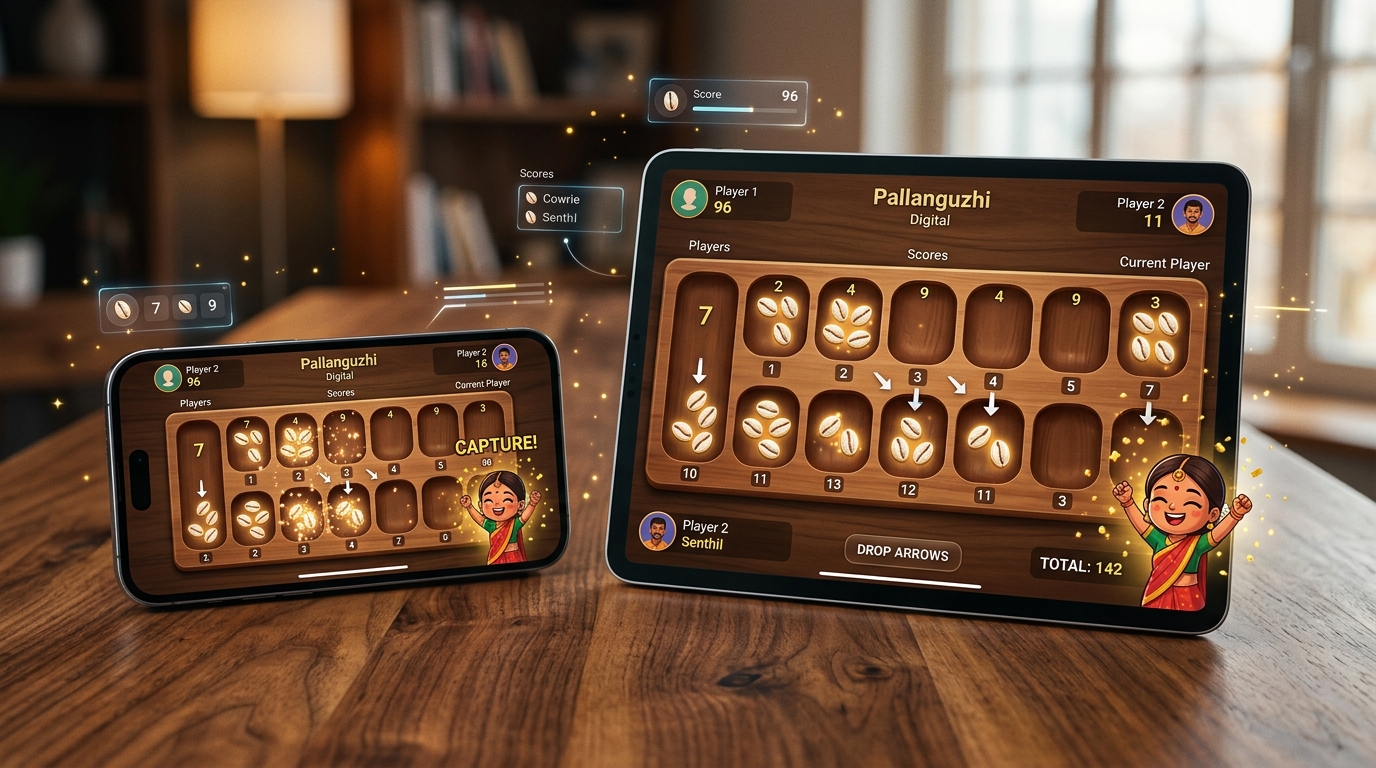
Available on Android, and iOS

Whether relaxing on your living room tablet, playing on your smartphone during commutes, or enjoying quick desktop matches, Pallanghuzhi is fully responsive, touch-optimized, and playable without installation via modern PWA technology.

ℹ️ Android app is available on Google Play. iOS app is available via Apple TestFlight.

Pallanghuzhi Mobile and Tablet Digital Board Game Mockup

Everything You Need to Know

What makes Pallanghuzhi's rules unique? ▾
Pallanghuzhi features a distinctive 14-pit layout (7 per player) with continuous circular chain sowing, multi-seed blank captures, the auspicious Pasu (Sacred Cow) rule on four shells, and sanctuary pits (Kasavu Kuzhi) during multi-round deficit tournaments.
What is the difference between Manual Mode and Auto Mode? ▾
In Auto Mode, the game automatically animates the sowing and scooping cascade once a pit is tapped. In Full Manual Mode, players physically tap the highlighted target pit for every drop, rainbow wheel scoop, cow claim, and capture—offering complete tactile physical mastery over each turn.
Is Pallanghuzhi the same game as Ali Guli Mane, Chenne Mane or Satkoli? ▾
Yes — they are the same 14-pit mancala board under different names in different languages: Pallanghuzhi in Tamil Nadu, Ali Guli Mane in Karnataka, Chenne Mane in Tulu Nadu, Akal Patta in North Karnataka and Satkoli in Maharashtra. The board, the 70 seeds and the core sowing maths are shared; the finer points differ slightly, and Ali Guli Mane is usually played as the Malay game Congkak.
Can I play against friends online? ▾
Currently, you can play against our expressive AI engine or challenge a friend via local 2-player pass-and-play. Real-time WebSocket room matchmaking for playing across different devices is planned as a future feature and is not yet implemented.